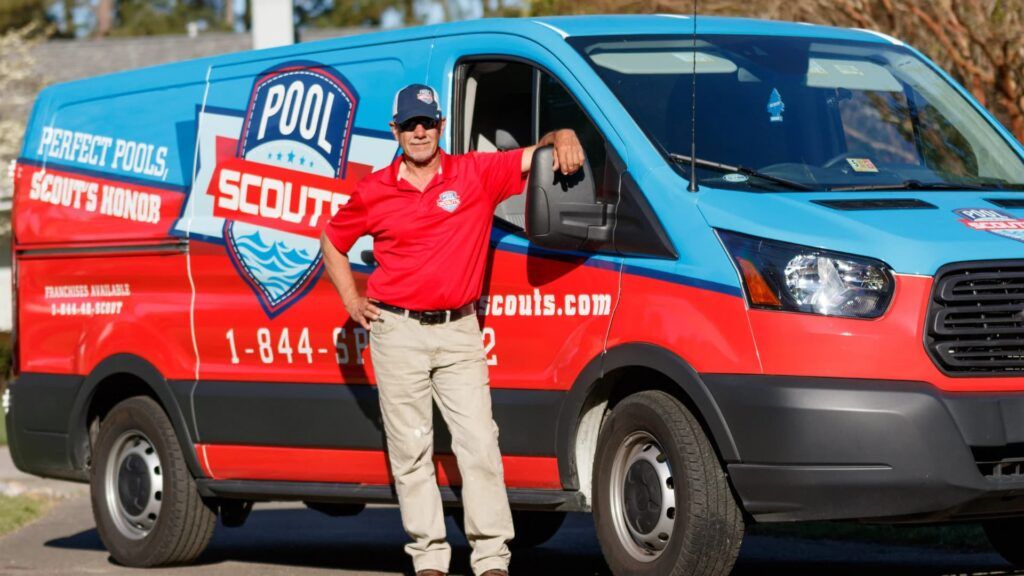



Pool Scouts is a residential pool cleaning and maintenance franchise that typically operates from home. According to Item 7 of its 2026 Franchise Disclosure Document (FDD), the estimated initial investment for one territory is $96,662 to $133,787, including a $50,000 franchise fee. The business combines recurring pool-service opportunities with responsibilities in local marketing, staffing, scheduling, and customer service.
This guide covers startup costs, ongoing fees, territories, training, ownership responsibilities, and questions to ask before investing.
About this article. Pool Scouts is a paying member of the Franchise Brokers Association (FBA). FBA is paid by the franchisors it works with, and FBA brokers earn a commission when a candidate they work with buys a franchise. Check every figure here against Pool Scouts’ current Franchise Disclosure Document (FDD), and review it with a franchise attorney before you invest.
What is a Pool Scouts franchise?
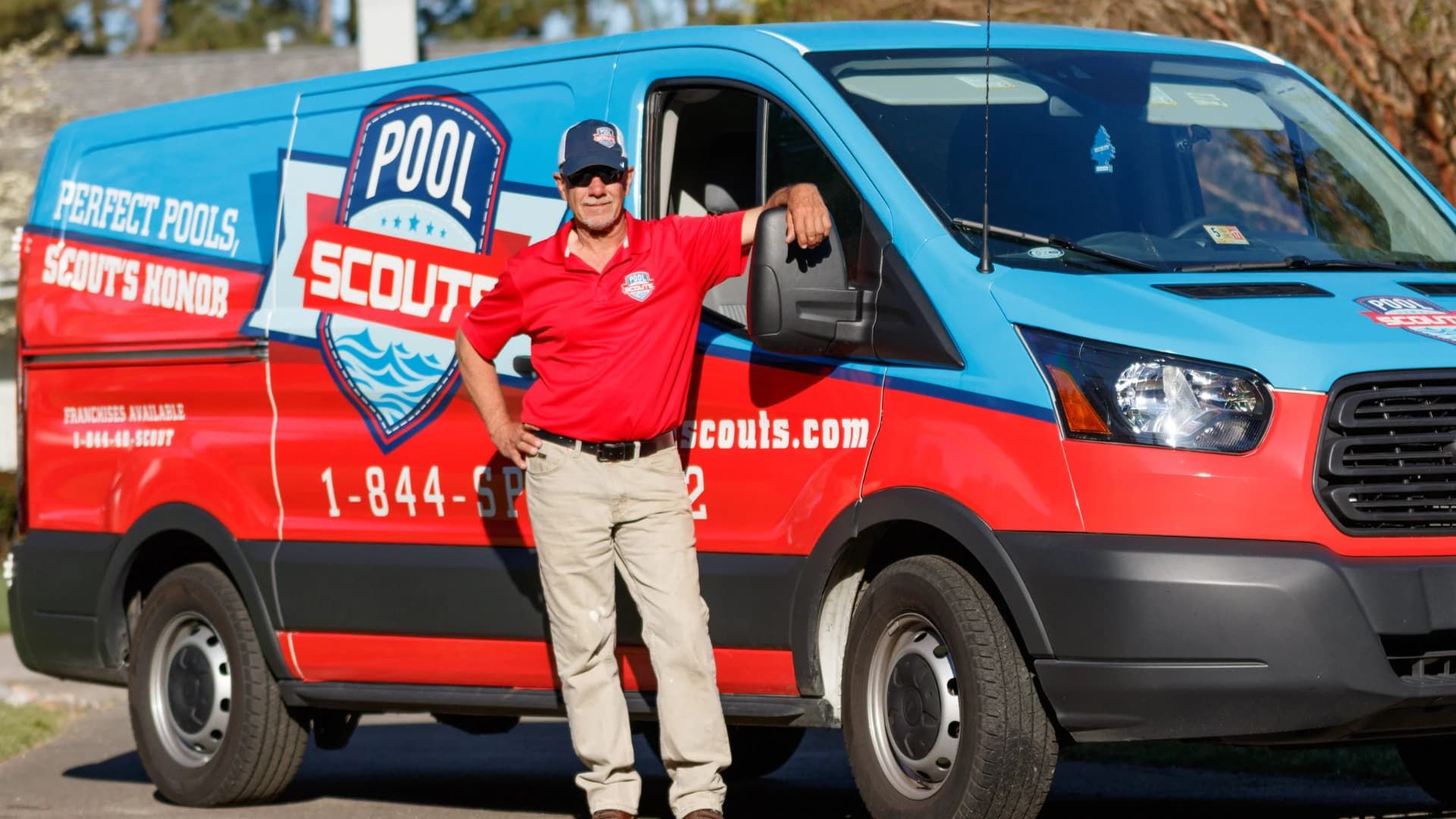
A Pool Scouts franchise provides residential pool cleaning and maintenance. Technicians visit customers’ properties to clean pools, manage water chemistry, and perform authorized maintenance. Repair services may provide additional opportunities, but the FDD notes that owners need the appropriate training, experience, and any required certifications or licenses to provide them directly.
The business typically operates from home rather than a retail storefront. However, local zoning and operating requirements may require commercial or office/warehouse space. Candidates should confirm requirements for vehicle parking, equipment, chemical storage, and business operations before assuming that their home is suitable.
How does a Pool Scouts franchise make money?
Pool Scouts offers recurring pool-service visits, along with services such as pool openings, closings, one-time work, and repairs. The mix depends on the market, season, and services the operator is qualified and authorized to perform. Recurring service creates opportunities for repeat business, but it does not guarantee renewals, customer retention, or profitability.
Three operating priorities deserve attention:
- Route density. The FDD identifies customer concentration, routing efficiency, and service type as factors affecting how many customers a truck can serve.
- Customer relationships. Owners need to deliver dependable service and communicate clearly to retain customers.
- Staffing. Recruiting, training, and supervising field employees are central responsibilities as service volume grows.
Seasonality also matters. The FDD describes service seasons that generally range from five to twelve months, depending on geography. A market with a shorter pool season requires a different staffing and cash-flow plan from one with demand throughout most of the year.
What does a Pool Scouts owner do?
A Pool Scouts owner oversees a service business—not simply a collection of pool-cleaning appointments.
Item 15 requires services to operate under the owner’s direct supervision and control or under an approved Designated Manager. That manager must successfully complete Operations Training before approval. Hiring a manager does not eliminate the owner’s obligations under the franchise agreement.
Responsibilities may include:
- Recruiting and supervising technicians.
- Monitoring schedules, routes, and service reports.
- Following up with prospective customers.
- Coordinating local marketing.
- Resolving customer concerns.
- Reviewing expenses, collections, and operating performance.
- Maintaining required licenses, insurance, and operating standards.
For example, an owner managing two technicians might review the day’s routes, adjust appointments when someone is absent, follow up on new inquiries, and check completed service reports. This is a hypothetical illustration, not a reported franchisee experience.
How much does a Pool Scouts franchise cost?
The estimated initial investment for one Pool Scouts franchise is $96,662 to $133,787, including the $50,000 franchise fee, according to Item 7 of the 2026 FDD. The estimate includes $20,000 to $40,000 in additional funds for the first three months.
| Selected startup cost | Estimated amount |
|---|---|
| Initial franchise fee | $50,000 |
| Mailer setup | $1,000 |
| Initial mailing list | $250 to $500 |
| Postcard fees | $10,000 |
| Initial SEO fee | $3,600 |
| Vehicle allowance | $1,950 to $5,100 |
| Vehicle decals | $3,500 to $7,000 |
| Additional funds for three months | $20,000 to $40,000 |
| Total estimated initial investment, including other Item 7 expenses | $96,662 to $133,787 |
Source: Pool Scouts 2026 FDD, Item 7. These are the franchisor’s estimates of startup costs, not results.
The table shows selected expenses, not every Item 7 line. Other listed costs include digital marketing, business management systems, a chatbot, training-related expenses, insurance, licenses, professional fees, and bookkeeping. Review the complete table and its notes before preparing a budget.
What the estimate assumes
The vehicle allowance is particularly important: Item 7 uses a limited initial leasing allowance rather than the full purchase price of a new vehicle. Buying vehicles instead of leasing them can change the cash required. The estimate also assumes home-based operations.
The three-month additional-funds allowance is not a promise that the business will become self-supporting within three months. The FDD states that additional working capital may be necessary during or after that period.
Use FBA’s franchise funding calculator to estimate your franchise budget, then build a separate operating and financing plan with qualified advisors.
Is there a franchise-fee discount?
Item 5 describes a $2,500 Community Heroes discount for qualifying buyers of a first Pool Scouts franchise. Eligible groups include firefighters, law enforcement personnel, emergency medical personnel, teachers, and educational administrative staff. The discount does not apply to franchises purchased under an area development agreement. Confirm eligibility and current terms directly with the franchisor.
What does it cost to open two or three territories?
Pool Scouts’ 2026 FDD lists cumulative franchise fees of $75,000 for two territories and $100,000 for three territories under an area development agreement. Item 7 gives a combined estimated investment range of $162,179 to $316,321 for two to three franchised businesses.
| Ownership arrangement | Franchise fee | Estimated total initial investment |
|---|---|---|
| One franchise | $50,000 | $96,662 to $133,787 |
| Two or three under area development | $75,000 for two; $100,000 for three | Combined disclosed range: $162,179 to $316,321 |
Source: Pool Scouts 2026 FDD, Item 7. These are the franchisor’s estimates of startup costs, not results.
The area development range is not a separate low-to-high estimate for each territory count. Its low end represents two businesses and its high end represents three, with assumptions about shared costs.
There are also development restrictions. Item 5 says the franchisor typically approves two-territory agreements, with three territories considered at its discretion for well-qualified, experienced buyers. The second business cannot open until the first has operated for at least twelve months.
A lower incremental franchise fee should not be confused with a low incremental operating cost. Additional territories can require more marketing, staffing, vehicles, and working capital.
What are Pool Scouts’ ongoing fees?
Pool Scouts franchisees pay a Royalty and Service Fee of 8% of Net Revenue and a Marketing Fee of 2% of Net Revenue, both monthly. Those percentage fees are only part of the ongoing cost structure.
| Fee or required expenditure | Disclosed amount or basis |
|---|---|
| Royalty and Service Fee | 8% of Net Revenue, monthly |
| Marketing Fee | 2% of Net Revenue, monthly |
| Digital marketing | Minimum $20,000 annually per territory, paid monthly |
| SEO | $3,600 annually per website; first-year amount paid upfront, followed by monthly payments in subsequent years |
| Postcards | 20,000 annually at the current $0.50 rate, or $10,000 per territory |
| Mailing list | Currently $0.05 per targeted household; Item 7 estimates $250 to $500 |
| Mailer setup | $1,000 per territory |
| Integrated Business Management Fee | $395 monthly for the first business, plus $50 monthly for each additional business |
| Required bookkeeping vendor | $350 monthly; $395 for combined bookkeeping and optional payroll service |
| Local marketing | Minimum $5,000 per calendar year within the territory |
Source: Pool Scouts 2026 FDD, Items 6, 7 and 11.
These are selected charges and spending requirements, not an exhaustive list. Additional charges can include the required chatbot, extra software or telephone accounts, convention-related charges, and other fees described in the FDD.
Budget for timing as well as totals
First-year marketing commitments can require cash before opening. Item 7 says the first season’s mailer fees are payable before the scheduled opening date, and the first year’s SEO fee is due when the website goes live. SEO is a per-website requirement, while the digital marketing minimum is per territory.
Item 11 also describes a separate advertising-expenditure schedule once a business reaches specified prior-year revenue thresholds. Required mailer and digital advertising expenditures count toward that schedule, so do not add every disclosed marketing figure together without checking the applicable rules.
Ask the franchisor for a written, territory-specific schedule showing required payments, due dates, and any spending credits.
What do Pool Scouts franchisees earn?
The 2026 FDD contains two distinct types of operating information:
- Affiliate results from PS Local Operations’ two-territory business in Virginia.
- Franchised-outlet results, including 2025 revenue grouped by class year for sixty outlets that had operated for at least twelve months as of December 31, 2025.
The franchised-outlet tables show averages, medians, highs, and lows. “Class year” means the first calendar year in which an outlet operated for at least six months—not necessarily the year its franchise agreement was signed. Separate tables address seasonal and year-round markets.
Source: Pool Scouts 2026 FDD, Item 19. Results are for the outlets the franchisor describes; yours may differ. Read the full Item 19 in the FDD.
This article does not reproduce the performance amounts. Read the complete tables and their notes before using them in a financial model.
Revenue is not owner income
The affiliate’s income statement uses the measure “Operating Cash Flow Before Non-Itemized Expenses.” Its notes exclude owner compensation and explain that other expenses may not be included. It is not a statement of what a franchise owner takes home.
The franchisor’s qualifier states:
“Some outlets have earned this amount. Your individual results may differ. There is no assurance that you will earn as much.”
Source: Pool Scouts 2026 FDD, Item 19. Results are for the outlets the franchisor describes; yours may differ. Read the full Item 19 in the FDD.
When reviewing Item 19, identify the entity, reporting year, outlet population, seasonality, and measure behind each figure. Read the median beside the average and ask which expenses remain outside the reported measure.
How big is the Pool Scouts system?
Item 19 reports thirty-seven franchisees operating seventy-one outlets as of December 31, 2025. It separately describes the affiliate’s two-territory operation. Franchisee counts and outlet counts are different: one owner may operate more than one outlet.
Source: Pool Scouts 2026 FDD, Item 19. Results are for the outlets the franchisor describes; yours may differ. Read the full Item 19 in the FDD.
For changes in system size, use Item 20’s year-by-year tables rather than combining figures from different database summaries. Review openings, terminations, nonrenewals, other closures, transfers, and reacquisitions separately.
Speak with current and former franchisees listed in the FDD. Ask why owners left, how transfers were handled, and whether experiences differed by market or opening year.
What litigation and bankruptcy disclosures should buyers review?
Item 3 describes two disputes involving former franchisees. According to the FDD, both were settled and dismissed with prejudice in 2025. The disputes involved franchise-related contractual and other claims; the franchisor denied the former franchisees’ allegations. Review the full disclosures and relevant agreements with a franchise attorney rather than treating a case count as a complete explanation.
Item 4’s bankruptcy disclosure concerns a personal Chapter 13 filing by a franchise-development executive and a joint filer in 2014, with a discharge entered in 2020. It is not a disclosure that the Pool Scouts franchisor filed for bankruptcy.
What training and support does Pool Scouts provide?
Item 11’s training section describes eight to ten days of classroom and field training. Elsewhere in the same item, the pre-opening assistance section describes an eight-day Operations Training program delivered virtually and in Virginia Beach, Virginia. Candidates should confirm the current schedule and required attendance directly with the franchisor.
The curriculum includes operations, pool-service activities, software, sales and customer service, recruitment, marketing, and financial management. Franchisees pay applicable travel, lodging, meals, and employee-related attendance expenses.
The FDD also describes:
- Operating manuals and approved supplier information.
- Marketing planning assistance and promotional materials.
- Telephone or internet operating support during normal business hours.
- Required scheduling and work-order systems.
- Additional training or meetings as specified.
- A requirement for customer calls to be answered by a live person in year one.
The typical estimated time from signing the franchise agreement to opening is sixty to 180 days. Licensing, equipment, financing, zoning, weather, and other factors can affect the timeline.
For broader franchise education, explore FBA’s free franchise education webinar and FranPath Live sessions.
How does a Pool Scouts territory work?
The FDD describes a territory containing up to 10,000 estimated targeted households. A targeted household is a single-family detached home with a pool or spa and estimated annual gross household income of at least $100,000. Territory boundaries are typically defined by ZIP codes.
The household count comes from third-party data, not a verified customer list or a guarantee of demand. The FDD acknowledges that mapping and mailing-list counts may differ.
What does exclusivity protect?
Item 12 states that franchisees receive an exclusive territory and describes restrictions on locating competing Pool Scouts outlets and direct solicitation by other franchisees. However, the filing also reserves rights relating to other distribution channels and addresses national or regional accounts and out-of-territory service. Exclusivity should therefore be read together with those provisions.
Before signing, ask:
- How many targeted households are actually assigned to the territory?
- How were the boundaries and household estimates produced?
- Which channels and accounts fall outside the practical protection?
- What happens to customers served outside the territory if that area is later awarded?
- What development obligations apply to a multi-territory agreement?
Who is Pool Scouts right for?
Pool Scouts may suit a service-oriented owner who wants to build and manage a residential service operation. The practical fit depends on the candidate’s management skills, available capital, local market, and willingness to oversee service quality—not simply enthusiasm for a recurring-revenue model.
It may suit candidates who:
- Enjoy customer relationships and local sales activity.
- Are comfortable recruiting and supervising technicians.
- Prefer measurable operating work such as scheduling, route efficiency, and expense control.
- Can support required spending while the customer base develops.
- Are willing to learn technical procedures and follow operating standards.
It may be a poor fit for candidates who:
- Want a passive investment.
- Do not want responsibility for employees or customer concerns.
- Assume home-based operations eliminate premises or storage requirements.
- Have not planned for seasonal changes in demand.
- Cannot fund required expenditures and potential additional working capital.
The FDD permits direct supervision by an owner or an approved Designated Manager, but either approach needs an operating plan and sufficient resources.
The Zorakle owner-fit assessment can support your broader ownership evaluation. You can also talk with a franchise consultant about how Pool Scouts compares with other service businesses.
What should you ask before buying a Pool Scouts franchise?
Before committing, review the full FDD with qualified advisors and speak with current and former owners.
Focus on these questions:
- Startup cash: What assumptions in Item 7 differ from your actual vehicle, premises, staffing, and financing plan?
- Marketing: What must be paid before opening, what applies per territory, and which expenditures receive credits?
- Owner involvement: What must the owner oversee, and what does an approved manager cost?
- Item 19: Which results describe affiliates versus franchisees, and which expenses are excluded?
- System history: What explains the outlet movements reported in Item 20?
- Territory: How concentrated are suitable households, and what protections and reserved rights apply?
- Seasonality: How do comparable owners manage winter staffing and cash needs?
- Compliance: Which licenses, certifications, chemical-handling rules, and storage requirements apply locally?
Pool Scouts franchise FAQ
How much does it cost to open a Pool Scouts franchise?
The 2026 FDD estimates $96,662 to $133,787 for one franchise, including the $50,000 franchise fee and $20,000 to $40,000 in additional funds for three months. Actual requirements may differ from the estimate.
What is the Pool Scouts royalty?
The Royalty and Service Fee is 8% of Net Revenue, paid monthly. A separate Marketing Fee is 2% of Net Revenue. Required marketing programs, business systems, bookkeeping, and other charges also apply.
Is a Pool Scouts franchise home-based?
Typically, yes. However, the FDD notes that local zoning may require commercial or office/warehouse space. Confirm local requirements before planning to operate from home.
How big is a Pool Scouts territory?
The FDD describes up to 10,000 estimated targeted households, typically within ZIP-code boundaries. The estimate is not a guarantee of actual pool-owning households or customer demand.
How long does it take to open a Pool Scouts franchise?
Item 11 estimates sixty to 180 days between signing the franchise agreement and opening, subject to factors such as licensing, financing, equipment, and local requirements.
Can you own more than one Pool Scouts territory?
Yes. The FDD offers area development arrangements for two or three businesses, subject to approval and development requirements. The cumulative franchise fee is $75,000 for two and $100,000 for three; the combined initial-investment range disclosed for two to three businesses is $162,179 to $316,321.
Can you hire a manager to run a Pool Scouts franchise?
Item 15 allows operation under an approved Designated Manager who successfully completes required training. This does not remove the owner’s contractual obligations or make the investment passive.
Ready to compare your options?
FBA can help you compare Pool Scouts with other franchise opportunities based on your budget, management experience, preferred involvement, and local market. Explore franchise options with an FBA consultant while continuing your independent review of the FDD and franchisee experiences.
Source notes and link list
- Pool Scouts Franchising, LLC, 2026 Franchise Disclosure Document, issued April 21, 2026. Accessed November 2026. Cited throughout, including Items 3 to 7, 11, 12, 15, 19 and 20.
- Pool Scouts franchise site, poolscoutsfranchise.com. Accessed November 2026. Brand background and support descriptions (franchisor-stated).
- Federal Trade Commission, A Consumer’s Guide to Buying a Franchise, ftc.gov. Accessed November 2026. General franchise due-diligence guidance.