

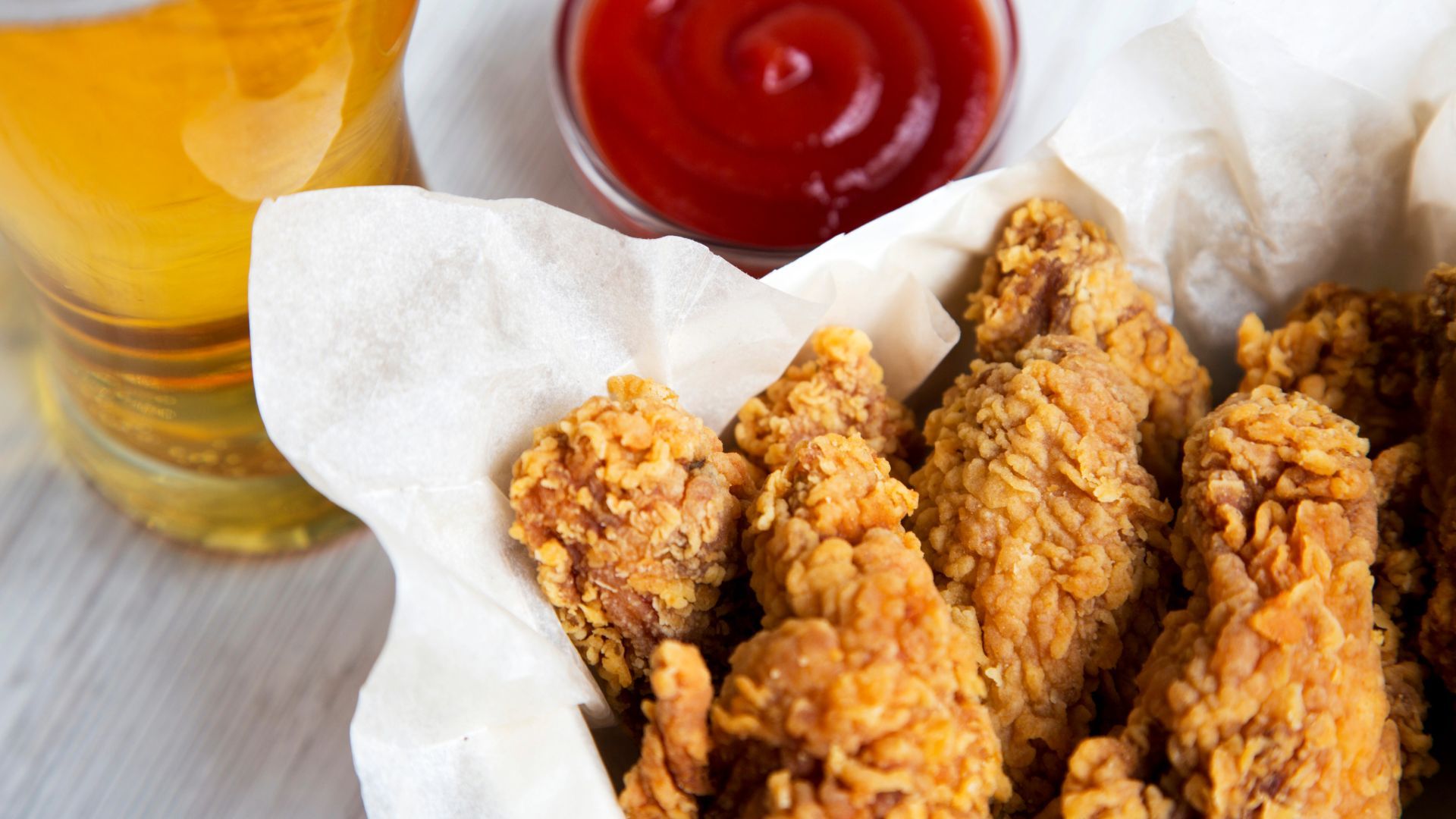
The Church’s Chicken franchise (branded in the U.S. as Church’s Texas Chicken™) occupies a middle ground in the chicken QSR space. It’s a 70-plus-year-old, value-oriented fried chicken brand with a bold Texas identity and flexible new “Blaze” prototypes—but still requires significant capital, operational intensity, and a very hands-on owner.
For many buyers, the real question isn’t “Is Church’s better than Popeyes, Raising Cane’s, or KFC?” but “Which concept actually fits my goals, budget, and lifestyle?” Church’s may appeal to experienced operators who like blue-collar trade areas and value pricing, while others may favor the scale of KFC, the cultural momentum of Popeyes, or the ultra-simple menu of Raising Cane’s.
A Church’s Chicken franchise combines legacy brand recognition, bold Texas positioning, and mid‑to‑high startup costs* with operational intensity and value‑driven guests. Popeyes and KFC often require higher total investment*, while Raising Cane’s is simpler operationally but rarely franchised in 2025. The best choice depends on fit, not popularity.
Disclosure: Church’s Chicken is not part of the Franchise Brokers Association (FBA) portfolio. This comparison is based on public information and objective criteria, not commissions. All cost figures marked with an asterisk (*) are estimates drawn from each brand’s most recent publicly referenced Franchise Disclosure Document (FDD) and reputable FDD summaries and can vary widely. This article does not make or imply any earnings, profitability, ROI, or “income potential” claims; for performance representations (Item 19), review the current FDD for each brand with your professional advisors.
Key Points at a Glance.
This comparison focuses on how the Church’s Chicken franchise stacks up against Popeyes, Raising Cane’s, and KFC on cost, support, operations, lifestyle, and fit for different types of owners.
- Church’s Chicken is a franchise: Church’s Texas Chicken™ (Church’s Chicken) operates as a franchise system in the U.S. under a detailed FDD and franchise agreement.
- Church’s Chicken franchise cost: Recent summaries based on the 2025 FDD place total initial investment for new U.S. units at roughly $644,000–$1,808,972* depending on the prototype and whether you convert an existing space or build new.
- Pros of Church’s Chicken: 70+ years of brand equity, “bold taste of Texas” positioning, a strong value focus, signature products (like Honey‑Butter Biscuits), and flexible “Blaze” prototypes for different real estate situations.
- Cons of Church’s Chicken: High staffing needs, long operating hours, operational intensity, a value‑oriented guest base that leaves less room for error, and a U.S. footprint that has been repositioning while global units grow.
- Popeyes at a glance: Larger global system, strong brand buzz and national marketing, broader menu, and typically higher build‑out costs* than many Church’s formats, with strict brand standards.
- Raising Cane’s at a glance: Simplified chicken‑finger menu and strong culture, but as of 2025 is generally not awarding new traditional U.S. franchises, so opportunities are very limited.
- KFC at a glance: Massive global brand with extensive marketing and training resources, but among the higher investment ranges* in the category and very structured operations.
For help matching brands to your profile (including many options beyond chicken), you can use FBA’s franchise search tool to explore by budget, lifestyle, and experience.
How Much Does It Cost to Open Church’s vs Popeyes, Raising Cane’s, and KFC?
A Church’s Chicken franchise generally falls in the low‑to‑mid seven‑figure range for total initial investment*, similar to Raising Cane’s historic ranges* and somewhat below the top end of Popeyes and KFC free‑standing builds*, which can reach into the high $2–$3 million range* depending on site and format.
Initial Investment & Fees Comparison (U.S., FDD‑Based Ranges)
| Concept | Church’s Chicken* | Popeyes* | Raising Cane’s* | KFC* | Notes |
| Initial Franchise Fee* | ~$20,000* | ~$54,755–$149,545* (varies by deal) | ≈$45,000* (historical FDD) | ~$48,575–$50,500* | Multi‑unit & development fees often apply. |
| Buildout / Leasehold Improvements* | Roughly $605,000–$693,000* (depending on Blaze format) | Roughly $700,000–$1,600,000* | Not publicly summarized in recent data (see FDD)* | Roughly $1,000,000–$1,900,000* | Highly site‑specific; ground‑up builds cost more. |
| Equipment / Signage* | Roughly $350,000–$380,000* | Roughly $340,000–$865,000* | Not disclosed in recent summaries* | Roughly $375,000–$606,000* | Includes kitchen, POS, menu boards, and exterior signage. |
| Opening Inventory / Supplies* | Roughly $6,000–$13,000* | Roughly $13,000–$26,000* | Not disclosed* | Roughly $10,000* | Food, paper, and initial smallwares. |
| Training / Travel* | Roughly $0–$23,000* | Roughly $17,000–$24,000* | Not disclosed* | Roughly $5,000–$8,000* | Depends on travel distance and team size. |
| Working Capital (first ~90 days)* | Roughly $10,000–$20,000* | Roughly $20,000–$30,000* | Not disclosed* | Roughly $50,000–$75,000* | Does not include owner salary. |
| Total Estimated Initial Investment* | ≈$644,366–$1,808,972* | ≈$504,545–$3,923,245* | ≈$768,100–$1,937,500* (historical) | ≈$1,052,825–$3,771,550* | All are high‑investment concepts relative to many other franchise categories. |
*Disclaimer: Data based on 2021–2025 Franchise Disclosure Documents (FDDs) and reputable FDD summaries where noted. Figures are estimates and may vary significantly by location, deal structure, and other factors. This content is informational and not financial, legal, or investment advice. Always rely on the current FDD and your advisors.
For your own budget planning, tools like the Franchise Financial Calculator can help you pressure‑test different investment ranges and capital structures before signing a franchise agreement.
What Are the Pros and Cons of a Church’s Chicken Franchise?
The Church’s Chicken franchise tends to attract experienced, well‑capitalized operators who like value positioning and are comfortable with operational intensity; it can be challenging for first‑time owners, under‑capitalized buyers, or people who dislike hands‑on QSR work.
Pros of Church’s Chicken.
- Legacy brand with Texas story: Founded in 1952 across from the Alamo in San Antonio, Church’s offers a 70‑plus‑year history and a clear “bold taste of Texas” brand story.
- Strong value positioning: Marketing and menu emphasize hearty, indulgent comfort food at sharp prices, resonating especially in blue‑collar and working‑class trade areas.
- Signature products: Hand‑battered chicken, Honey‑Butter Biscuits, classic sides, and rotating limited‑time flavors create a base of loyal fans in core markets.
- Flexible Blaze prototypes: Blaze compact, conversion, end‑cap, and larger 1400 Blaze models give multiple paths into the system, including potential conversions of existing restaurant boxes.
- Global scale and growth: With well over a thousand units worldwide and a growing international footprint, Church’s has scale while still pursuing new markets and remodels.
- Franchise‑centric growth strategy: Leadership emphasizes franchising and unit growth, with an explicit focus on franchisee partnerships, remodel programs, and digital evolution.
- Support praised by some franchisees: Public interviews with multi‑unit Church’s franchisees mention strong launch support, training, and corporate collaboration around openings and marketing.
Cons of Church’s Chicken.
- Operationally intense: As a full fried‑chicken QSR with drive‑thru, Church’s requires significant staffing, tight food safety controls, and disciplined execution on speed and hospitality across long hours.
- Value‑focused guest base: A price‑sensitive customer base leaves limited room for error on food and labor cost control; consistent operations and careful pricing are essential.
- Repositioning in the U.S.: While global units grow, the U.S. brand story has included closures, remodels, and a “comeback” narrative, which can create both opportunity and risk depending on the market.
- Crowded competitive set: Church’s often competes head‑to‑head with KFC, Popeyes, Raising Cane’s, and strong regional chicken players, plus independents, in many trade areas.
- High capital and net‑worth expectations: Public FDD summaries and franchise marketing materials suggest that the brand targets multi‑unit operators with seven‑figure net worth and substantial liquid capital.
- Brand and legal scrutiny: Regulatory and competitive scrutiny in the chicken category is high, and large competitors closely protect their brand assets and marketing positions.
- Not a “set and forget” asset: Church’s own materials and franchisee stories emphasize engaged ownership and multi‑unit ambitions; it is not positioned as a passive investment.
What Is Day‑to‑Day Life Like in These Chicken Franchises?
Daily life in a Church’s Chicken franchise resembles many busy fried‑chicken QSRs: long hours, heavy drive‑thru business, a sizable team, and constant focus on food quality and speed; Popeyes, Raising Cane’s, and KFC share these fundamentals but differ in complexity, menu focus, and brand structure.
Church’s Chicken: Owner Role & Lifestyle.
A typical Church’s Chicken franchisee can expect to be actively involved, at least for the first several units, with responsibilities that extend beyond pure oversight.
Common realities include:
- Owner role: The system is oriented toward hands‑on, multi‑unit franchisees. Even with strong managers, owners are expected to be present during openings and engaged in coaching, operations, and community relationships.
- Hours: Stores generally operate seven days a week, with lunch and dinner peaks and extended evening hours; owners often work a combination of early prep, peak shifts, and late closes, particularly during ramp‑up.
- Staffing: A full‑service fried chicken QSR commonly employs 20–30+ people across all shifts, including a general manager, shift leaders, cooks, drive‑thru staff, and front‑of‑house team members.
- Operational focus:
- Managing batter mixes and cook cycles for fresh chicken
- Ensuring fryer and food‑safety standards are met
- Hitting drive‑thru speed‑of‑service goals
- Rolling out limited‑time offers and promotions on schedule
- Managing batter mixes and cook cycles for fresh chicken
- Local marketing: Church’s emphasizes community presence, such as school fundraisers, local events, and value‑driven campaigns that reinforce its Texas roots and bold‑flavor positioning.
Anyone considering a Church’s fried chicken franchise should be comfortable leading teams in a fast‑paced, guest‑facing environment.
Popeyes: Snapshot of Day‑to‑Day.
Popeyes franchisees typically manage high‑volume, heavily promoted restaurants with a broad menu.
- National and regional marketing campaigns can create large, sometimes sudden, swings in traffic.
- Brand standards around product quality, speed, and guest experience are highly defined and enforced.
- Multi‑unit operators often manage clusters of free‑standing or end‑cap units with significant staffing and managerial layers.
- For a deeper dive, see Popeyes franchise overview.
Raising Cane’s: Snapshot of Day‑to‑Day.
Raising Cane’s offers a much narrower menu but still a demanding operation.
- Operations focus on chicken fingers, fries, slaw, toast, and signature sauce, which simplifies prep but raises expectations for consistency and speed.
- The brand promotes a strong service culture and energetic in‑store experience.
- As of 2025, most locations are corporate‑owned or legacy franchise units, with very limited traditional U.S. franchising.
Our article about Raising Cane’s franchise pros and cons article covers the concept at a high level, but many buyers will need to consider other options if they want a chicken concept they can actually join.
KFC: Snapshot of Day‑to‑Day.
KFC franchisees operate within one of the largest and most structured QSR systems in the world.
- Units often have complex kitchens, large dining rooms or drive‑thru operations, and high order volumes.
- KFC’s brand standards and operating manuals are detailed and must be followed closely.
- Many franchisees are large multi‑unit operators with developed infrastructure (district managers, HR, training teams).
- For more context, see KFC franchise overview.
Training, Support & Technology at Church’s Texas Chicken.
Church’s Texas Chicken provides structured training, launch support, and expanding digital tools, but it still expects franchisees to own local execution and day-to-day performance.
Church’s Texas Chicken: Support Strengths & Gaps.
Church’s support model blends corporate systems with a strong expectation that owners will handle key aspects of execution.
Key elements:
- Training: Franchisees and managers typically complete multi-week training on operations, food safety, leadership, and financial basics, followed by in-restaurant opening support from corporate teams.
- Real estate & development assistance: The franchisor helps create a market development plan, reviews trade areas, and supports restaurant design, while franchisees work with their own brokers, architects, and contractors.
- Marketing & loyalty:
- Participation in national and regional campaigns focused on flavor and value
- Access to the Real Rewards loyalty program and mobile app to drive repeat visits and digital ordering
- Participation in national and regional campaigns focused on flavor and value
- Technology: Church’s has invested in digital menu boards, online ordering, and loyalty tools (especially in the U.S.), though franchisees should still expect a hands-on role in using these tools effectively in their local market.
Owners who like a balance of structure plus room for local initiative may appreciate Church’s approach; those wanting an almost fully “turnkey” system should pay close attention to how much responsibility still rests at the unit level.
Territory, Real Estate & Equipment at Church’s Texas Chicken.
Church’s balances flexible Blaze prototypes and conversion options with the substantial real estate and equipment demands typical of fried-chicken QSRs. Franchisees receive guidance, but they are ultimately responsible for securing sites, negotiating deals, and managing development.
Church’s Texas Chicken: Territory, Sites & Equipment.
Church’s franchisees operate within defined development plans and must secure suitable locations that meet brand standards.
Territory: The FDD outlines territory rights and development expectations, often including minimum opening schedules and rules for non-traditional or digital formats.
Real estate & prototype options:
- Blaze Compact Model: Smaller freestanding building optimized for drive-thru.
- 1400 Blaze Image Model: Larger footprint with dine-in capacity and full drive-thru.
- Conversion Blaze Model: Designed to retrofit existing restaurant buildings.
- End Cap Blaze Model: Inline or end-cap spaces in shopping centers.
Equipment: Significant capital is tied to pressure fryers, ventilation and hood systems, walk-in coolers/freezers, prep lines, POS systems, digital menu boards, and drive-thru hardware—all requiring ongoing maintenance and compliance with brand specifications.
Site support: Church’s assists with trade-area planning, prototype design, and brand standards, while franchisees manage site selection, negotiations, permitting, construction, and local timelines.
Owners considering Church’s should be prepared for a hands-on development process typical of full-kitchen QSR models, even with the flexibility of its Blaze formats.
Units & Growth Trajectory (Non‑Financial).
Church’s is a global chicken brand with ambitious expansion plans, particularly internationally, while Popeyes and KFC continue to grow from much larger footprints, and Raising Cane’s grows rapidly but mostly through corporate units.
- Church’s Chicken:
- Public reports describe roughly 1,400–1,500 restaurants in more than 20 countries, with about 750–785 in the United States and a heavy concentration in Texas.
- The brand has announced plans for hundreds of additional restaurants worldwide over several years, supported by updated prototypes and new market entries.
- In the U.S., the story includes both remodels and repositioning, with some closures and a focus on improving brand relevance and experience.
- Public reports describe roughly 1,400–1,500 restaurants in more than 20 countries, with about 750–785 in the United States and a heavy concentration in Texas.
- Popeyes: Thousands of units globally and a large U.S. presence, with continued net unit growth and high brand visibility.
- Raising Cane’s:Hundreds of locations and rapid expansion, largely via company‑owned units and selective partnerships, with a very focused menu and brand identity.
- KFC:Tens of thousands of restaurants worldwide under Yum! Brands, including a substantial U.S. footprint and ongoing remodel and development programs.
Unit counts and growth trends do not predict the performance of any specific restaurant, but they do influence market saturation and the amount of “white space” available.
Risks & Watch-Outs for Church’s Texas Chicken.
Like most QSRs, Church’s faces labor challenges, food cost volatility, and heavy competition—but there are also Church’s-specific issues you’ll want to dig into during due diligence.
Church’s Texas Chicken: Key Watch-Outs.
Prospective Church’s franchisees should look closely at:
- Value-oriented positioning: The guest base is highly price-sensitive, so tight cost control, menu mix, and promo discipline are critical.
- U.S. repositioning: Remodels, prototype changes, and some market exits make it important to review Item 20 (openings/closures) and speak with local franchisees about real-world performance.
- Operational demands:
Fryers, a hot kitchen, drive-thru, and strong peak periods require comfort with complex operations, staffing, and training. - Franchisor–franchisee dynamics: Item 3 (litigation) and conversations with current and former operators can surface patterns in support, communication, and conflict resolution.
- Supply chain structure: Approved vendors and purchasing requirements can affect food costs and limit local sourcing flexibility—understand how this plays out in your market.
- Development obligations: Multi-unit development schedules may require aggressive build-outs and sufficient capital to keep pace with your agreement.
When Is a Church’s Chicken Franchise NOT the Best Fit?
A Church’s Chicken franchise is often a poor match when a buyer wants low capital, light staffing, or minimal involvement rather than a full‑scale restaurant.
You may want to consider other options if:
- Your available capital is well below the $644k–$1.8M+ total investment* range per store (plus working capital and reserves).
- You want a small, low‑staff business, such as boutique services, home‑based consulting, or niche fitness, rather than a full restaurant.
- You are seeking semi‑absentee ownership from day one, with limited time in the business.
- You feel uneasy serving a price‑sensitive, value‑driven guest base where operational discipline is crucial.
- Your target market is already crowded with major chicken players and strong local competitors.
- You prefer premium or luxury positioning over value‑oriented comfort food.
Is Church’s Texas Chicken the Right Fit for You?
The “right” franchise depends on your capital, skills, risk tolerance, and lifestyle goals—not on a universal ranking. Church’s Texas Chicken is best suited to owners who are comfortable with a full-time, operationally involved restaurant business.
Church’s Texas Chicken: Lifestyle & Fit Snapshot.
- Owner role: Best fit for full-time owner-operators or experienced multi-unit owners who stay close to the numbers and the team. Semi-absentee setups may be possible but usually require a very strong, trusted GM.
- Staffing & hours: Expect a high staffing load, active hiring and training, and consistent nights/weekends. This is a true B2C, guest-facing environment.
- Operational feel: Medium–high complexity: fryers, drive-thru, hot kitchen, tight food safety standards, and busy peaks. You’ll need good systems and a strong leadership bench.
Church’s Texas Chicken: Best For / Consider If / Not Ideal If.
- Best for: Experienced restaurant or multi-unit operators seeking a value-oriented chicken brand with flexible real estate formats and a legacy Texas identity.
- Consider if: You have access to seven-figure capital, enjoy hands-on operations, and see upside in helping a legacy brand re-assert itself in select trade areas.
- Not ideal if: You want a simple, low-touch, or part-time business—or prefer a model with lighter staffing, fewer moving parts, or more traditional business hours.
Beyond chicken, FBA brokers work with many non‑food concepts in home services, B2B, senior care, fitness, and more. A smart starting point is taking the Zorakle franchise assessment to clarify your strengths and ideal model before you commit to any brand.
FAQ: Common Questions About the Church’s Chicken Franchise
These FAQs address common questions buyers ask about church’s chicken franchise cost, requirements, lifestyle, and comparisons, without making earnings or income claims.
1. Is Church’s Chicken a franchise?
Yes. Church’s Texas Chicken™ operates as a franchise system in the U.S. Franchisees sign an agreement governed by a Franchise Disclosure Document (FDD) that outlines fees, territory, obligations, and support. In return, they follow Church’s system, recipes, and brand standards. If you want to compare Church’s to other categories, FBA’s franchise search tool is a helpful starting point.
2. How much does a Church’s Chicken franchise cost?
Recent FDD-based summaries place the total estimated initial investment around $644,000 to $1,808,972* for new builds or conversions, depending on the Blaze format and site conditions. This usually includes build-out, equipment, inventory, training, and initial funds—but not land or your personal living expenses. Always verify the latest range in the current FDD and with the franchisor.
3. What are the main Church’s Chicken franchise requirements?
Church’s typically looks for both financial capacity and relevant experience. Summaries often cite minimum net worth in the seven figures (around $1,000,000 or more)* and liquid capital in the low- to mid-six figures (around $300,000 or more)*, plus prior restaurant, hospitality, or multi-unit retail experience. Exact thresholds and approval decisions are up to the franchisor; an FBA broker can help you interpret whether you may qualify.
4. How much is a Church’s Chicken franchise really, including ongoing fees?
The initial investment (Item 7) is only part of the picture. You’ll also have ongoing fees (Items 5 and 6) such as royalties, national/regional/local advertising, and possible technology or system fees, plus future reinvestment for remodels, equipment replacement, and local marketing
Because this picture can be complex, many candidates run scenarios with tools like the Franchise Financial Calculator and then review assumptions with an accountant and franchise attorney.
5. Can I buy a Church’s Chicken franchise for sale instead of building from scratch?
Sometimes. In certain markets, existing Church’s locations become available when current owners sell or reorganize. You may save on ground-up construction but should budget for remodels or upgrades, and carefully review historical financials, the lease, and upcoming capital needs.
FBA brokers regularly help buyers evaluate both new builds and resales; if you’re primarily interested in resales, mention that early in a franchise consulting conversation.
6. What is daily life like owning a Church’s fried chicken franchise?
Expect a fast-paced, people-heavy operation: managing a hot kitchen, fryers, drive-thru, and a sizable team, often during nights, weekends, and holidays. Like most major chicken QSRs, this is a hands-on, full-time business rather than a low-involvement side project.
Is This Chicken QSR Category — and Church’s — the Right Fit for You?
Chicken QSR franchises can provide strong brands and established systems, but they demand substantial capital, time, and resilience. Church’s Chicken adds the twist of a legacy Texas‑rooted brand with value positioning, flexible prototypes, and an active comeback narrative.
Key points to consider:
- The chicken QSR category generally means:
- High initial investment and ongoing reinvestment.
- Significant staffing and leadership needs.
- Seven‑day operations and peak‑time pressure.
- Competitive markets and rapidly shifting consumer preferences.
- High initial investment and ongoing reinvestment.
- A Church’s Chicken franchise specifically may fit if:
- You like its Texas heritage and value focus.
- You are comfortable in a hands‑on restaurant environment.
- You have the capital and appetite to develop multiple units over time.
- You like its Texas heritage and value focus.
And it may not fit if you’re looking for:
- A lower‑investment, part‑time, or home‑based franchise.
- A concept with fewer operational moving parts and smaller teams.
- A brand with a more mature and stable U.S. growth story.
If you’re exploring whether chicken QSR — or franchising in general — aligns with your goals, you might also benefit from FBA’s educational franchise webinar or by listening to the FranPath Live podcast for real owner stories and expert interviews.
Ready to take the next step? The Franchise Brokers Association is here to help guide you on your journey into the franchise world.