


Is owning a franchise profitable? A franchise can be “profitable” when the unit-level math works (revenue drivers and costs leave sustainable surplus) and when the model fits your market and your role as an owner. But there’s no guarantee—results vary by location, operator execution, staffing, and local conditions.
This article is for informational and educational purposes only and is not legal, financial, or tax advice. Always consult qualified professionals and review the franchisor’s Franchise Disclosure Document (FDD) before making decisions.
When people ask “is owning a franchise profitable,” they’re really asking whether a single location can produce reliable surplus cash flow after costs and required fees.
If you’re asking “is owning a franchise profitable,” focus on repeatable demand, controllable costs, and owner-role fit. Use the FDD (especially Items 6, 7, 11, 19, and 20) plus franchisee validation to confirm what’s true in real life.
What makes a franchise “profitable” in plain English?
A franchise is financially sustainable when a typical unit can consistently produce enough gross margin to cover operating costs, required franchise fees, and working-capital needs—leaving room for owner compensation and reinvestment (which varies widely).
If you’re wondering is owning a franchise profitable, start by testing whether the location-level model can stand on its own.
Begin with unit-level economics, meaning the revenue-and-cost picture of one location (or one defined territory/service route). If a single unit can’t support its cost structure, adding more units usually adds complexity—not certainty.
A practical way to frame the math is:
- Revenue drivers: How customers find you, choose you, and return
- Variable costs: Costs that rise as sales rise (materials, product, some labor)
- Fixed costs: Costs you pay even during slow periods (rent, insurance, baseline payroll)
- Required franchise fees: Ongoing royalties, brand marketing contributions, tech fees, and similar requirements
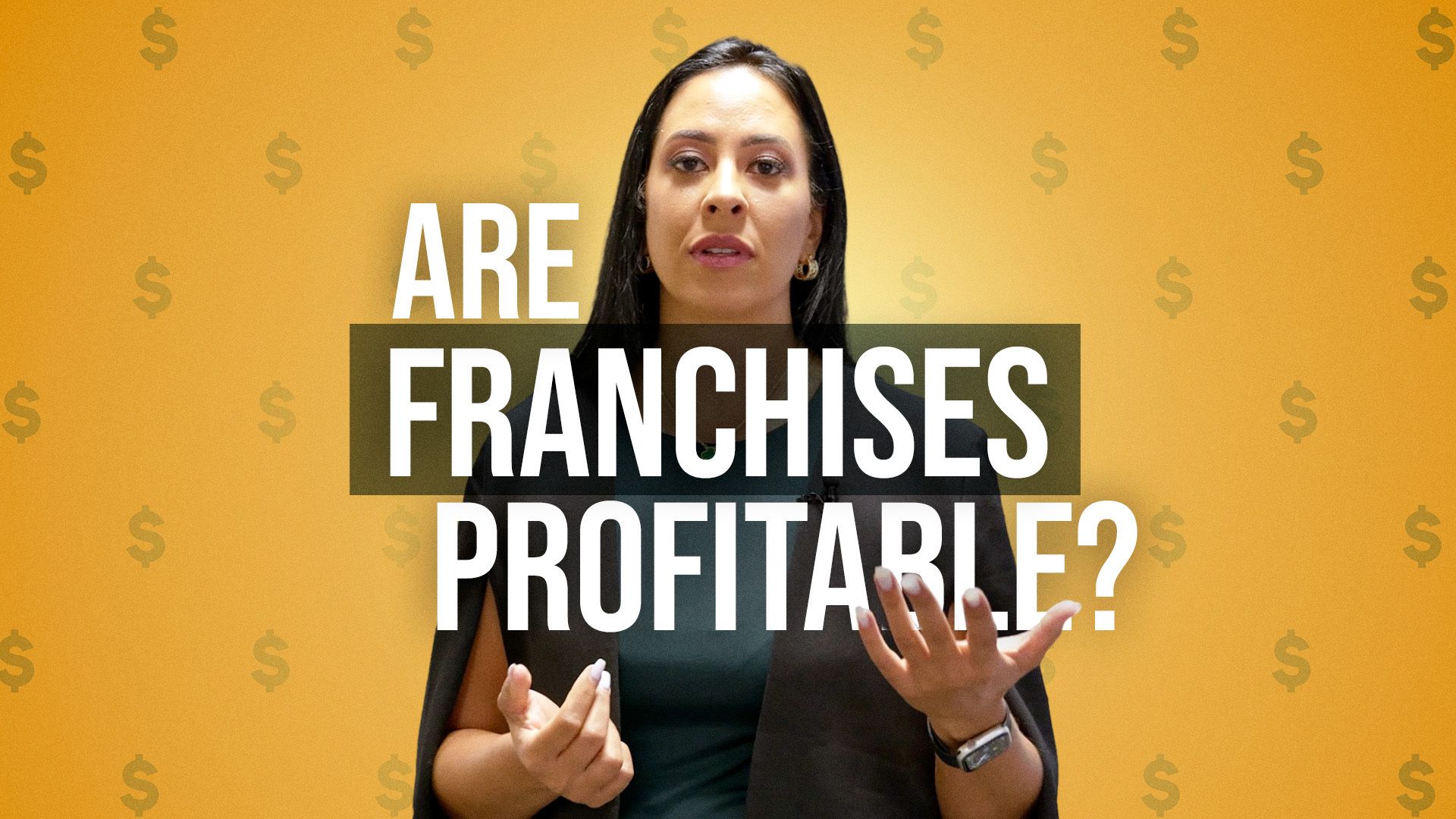
In the video, the speaker points to three factors you can control that influence outcomes:
- Being properly capitalized so you can launch and ramp without cutting corners
- Using the FDD to validate requirements and disclosures instead of relying on assumptions
- Picking a concept that fits your skills (some models need more sales/networking; others lean more on operations leadership)
Is Owning a Franchise Profitable when you break down the drivers?
Is owning a franchise profitable depends on three buckets you can evaluate: (1) demand and pricing power, (2) controllable costs, and (3) the owner’s job inside the system. Your goal isn’t to “guess a number”—it’s to confirm the model has durable levers you can manage.
Revenue quality matters more than “big numbers.”
Revenue isn’t just “more customers.” It’s how predictable demand is and how expensive it is to generate.
If you’re evaluating franchise opportunities, pressure-test revenue with questions like:
- Customer source: What channels reliably produce leads or foot traffic?
- Conversion: What percent of prospects buy once they engage?
- Average transaction: What’s typical per visit/order (and what drives upsells)?
- Frequency/recurrence: Do customers come back on a schedule?
- Capacity: What limits growth—labor, equipment, hours, vehicles, space?
- Seasonality: Are there slow months that require extra reserves?
Costs usually decide whether the model breathes or breaks.
If you’re asking is buying a franchise profitable, you have to understand the cost stack you’ll manage week to week:
- COGS/materials: Product, supplies, or direct service delivery costs.
- Labor: Wages, payroll taxes, scheduling, overtime, turnover.
- Occupancy: Rent, CAM/NNN charges (if applicable), utilities.
- Local marketing: Required minimums plus what’s needed in your market.
- Royalties & system fees: Ongoing payments required by the franchise agreement.
- Insurance & compliance: Required coverage and local licensing.
- Technology fees: POS/CRM, scheduling tools, reporting systems.
A clean way to evaluate cost pressure is to track percent-of-sales metrics (without assuming any “typical” level):
- Gross margin %: How much is left after direct costs.
- Labor %: Labor cost relative to sales volume.
- Occupancy %: Rent/occupancy relative to sales volume.
- Customer acquisition cost (CAC): What it costs to gain a new customer.
- Lifetime value (LTV): What a customer tends to spend over time.
If you want a deeper education track on terminology and diligence basics, start with the FBA education blog.
How does your owner role change the path to profitability—especially semi-absentee?
Your owner role can change outcomes because it affects daily execution, oversight, and staffing structure. If you’re asking is owning a franchise profitable, you need to evaluate whether the business model matches how you’ll actually operate—hands-on, manager-led, or somewhere in between.
Many buyers underestimate how much the owner role influences results. In the video, the speaker makes a practical point: some concepts lean heavily on networking, relationship-building, and a consistent sales routine, while others lean more on management discipline and team leadership. If your strengths don’t match the model, the unit can underperform even if the concept looks strong on paper.
If you’re evaluating is opening a franchise profitable, treat “fit” as a real diligence category—not a personality quiz. A brand that requires frequent selling and community outreach may frustrate an owner who prefers back-end operations. On the other hand, a process-heavy concept may feel slow to someone who thrives in fast-paced sales environments.
Owner-operator and manager-run models have different risk points.
Owner-operator (hands-on) tends to rely on:
- Personal sales effort or local relationship building
- Tight daily control of labor and service quality
- Faster operational learning loops (you see problems immediately)
Semi-absentee / executive model tends to rely on:
- A capable manager (recruiting, training, retention)
- Clear KPIs and reporting cadence
- Documented processes and a culture of accountability
- Strong franchisor support and field coaching
What to validate for semi-absentee fit:
- Whether the franchisor explicitly supports semi-absentee ownership
- What training is designed for owners vs. managers
- How performance is measured (dashboards, audits, field visits)
- Whether lead generation is centralized, local, or both
If you want help matching your preferred owner role to the right business model, you can connect with an FBA broker to explore options objectively.
How do you evaluate “how profitable is a franchise” without making assumptions?
To evaluate how profitable is a franchise responsibly, rely on disclosures (FDD), operational requirements, and franchisee validation—not hype, social posts, or informal claims. Profitability varies, and your job is to confirm the model’s economics and execution demands.
The FTC emphasizes that you must receive the FDD before signing or paying, and it’s a core part of responsible evaluation.
Here are the most decision-relevant sections for a profitability framework:
- Item 6 (fees): Royalties, brand marketing fund, tech fees, renewal/transfer fees.
- Item 7 (initial investment): Startup cost categories and ranges (not outcomes).
- Item 11 (support): Training, field support, marketing support, tech systems.
- Item 12 (territory): Protected territory rules and exceptions.
- Item 19 (optional): Financial Performance Representations (FPRs), if provided.
- Item 20 (outlets): Openings/closures/transfers + franchisee contact info.
What is Item 19, and what if it’s missing?
Item 19 is where a franchisor may provide substantiated financial performance representations, but many franchisors provide no Item 19 data at all. If they do make FPRs, federal rules require a reasonable basis, written substantiation, and disclosure in Item 19.
If there’s no Item 19, that doesn’t automatically mean the model is “bad.” It means you must lean harder on operational diligence and franchisee validation—and you should be cautious about any numbers shared outside the FDD, since financial performance representations have strict rules.
Why Item 20 is a practical “system health” check.
In short: Item 20 helps you understand outlet trends (openings, closures, transfers) and provides contact information for current and recent former franchisees—critical for validation conversations.
Use Item 20 to form questions like:
- Are closures concentrated in certain regions or formats?
- Are transfers common (and why)?
- Are projected openings realistic relative to support capacity?
For more education on the franchise process and disclosures, visit the Franchise Brokers Association homepage and the FBA franchise search to compare models by owner role and category.
What questions should you ask to validate whether a franchise can be profitable?
Validation is how you learn what the model feels like in the real world—staffing challenges, sales process, local marketing demands, and support quality. If you’re asking is being a franchise owner profitable, your validation questions should map to the levers that create (or destroy) consistency.
Use this checklist and ask the same core questions across multiple franchisees:
- Ramp-up reality: What surprised you in the first 90–180 days?
- Lead flow: Where do customers actually come from in your market?
- Sales process: What skills matter most day-to-day (sales vs ops vs hiring)?
- Staffing: What roles are hardest to hire and retain?
- Scheduling: What causes labor spikes and how do you manage them?
- Cost control: Which costs get out of hand fastest without systems?
- Support quality: How often do you hear from support and what’s useful?
Do a break-even exercise to test “how the business breathes.”
Break-even is a planning tool that estimates the point where total revenue equals total costs—no loss or gain. You don’t need perfect numbers to learn from it. Even a rough model helps you see which variable changes matter most (pricing, labor, occupancy, close rate, etc.).
Hypothetical example for education (not typical or predictive): If fixed costs rise or staffing efficiency drops, the break-even point moves up—meaning the business needs more consistent demand to stay stable. The takeaway isn’t “what you’ll make,” but which levers you must manage weekly.
FAQ: Franchise Profitability.
Is opening a franchise profitable compared to starting from scratch?
It can be, because franchising may provide a proven operating system and support—but outcomes still depend on market fit, execution, and cost control. Use the FDD and franchisee validation to compare the system you’re buying, not just the brand name.
How profitable is a franchise if Item 19 is not provided?
You can’t responsibly generalize without Item 19 data, so you should focus on operational proof, fees, support, and franchisee interviews. Be cautious of numbers shared outside formal disclosures because financial performance representations are regulated.
What costs surprise new franchisees most often?
Staffing friction, local marketing needs, and “small” recurring expenses (tech, repairs, compliance) often surprise buyers more than one-time startup line items. The FTC also notes that ongoing fees and required payments can apply regardless of how the outlet is performing.
Is being a franchise owner profitable in a semi-absentee model?
It can be viable when the concept supports manager-led execution and the franchisor provides strong training, reporting, and field coaching. Validate how the franchisor defines “semi-absentee” and what structure successful owners use in practice.
How long does it take for a franchise to “stabilize” after opening?
There’s no universal timeline because ramp-up depends on market demand, staffing, training, and local marketing effectiveness. Treat stabilization as a diligence topic: ask multiple franchisees what changed between month 1 and month 6.
Is this the right way to decide if owning a franchise is profitable for you?
If you want a structured way to answer is owning a franchise profitable, this framework is built for you: unit economics + FDD verification + validation calls + owner-role fit. If you’re looking for guaranteed outcomes or a fully passive investment, you’ll need to reset expectations and explore alternatives aligned with your risk tolerance.
This framework is often a fit for:
- Buyers who prefer measurable levers and systems
- Career changers who want clarity on the owner role
- Semi-absentee seekers willing to build management structure
- Due-diligence readers who will read the FDD carefully
You may want to explore other paths if:
- You want minimal oversight and minimal involvement
- You dislike hiring, coaching, or local relationship-building
- You won’t validate with multiple franchisees
- You’re uncomfortable with franchisor controls and ongoing fees
Before you decide:
- Review the FDD with a franchise attorney and CPA
- Speak with current and former franchisees (Item 20 contacts)
- Confirm the day-to-day role you actually want
- Build a conservative working-capital and break-even plan
Ready to take the next step? The Franchise Brokers Association is here to help guide you on your journey into the franchise world.