


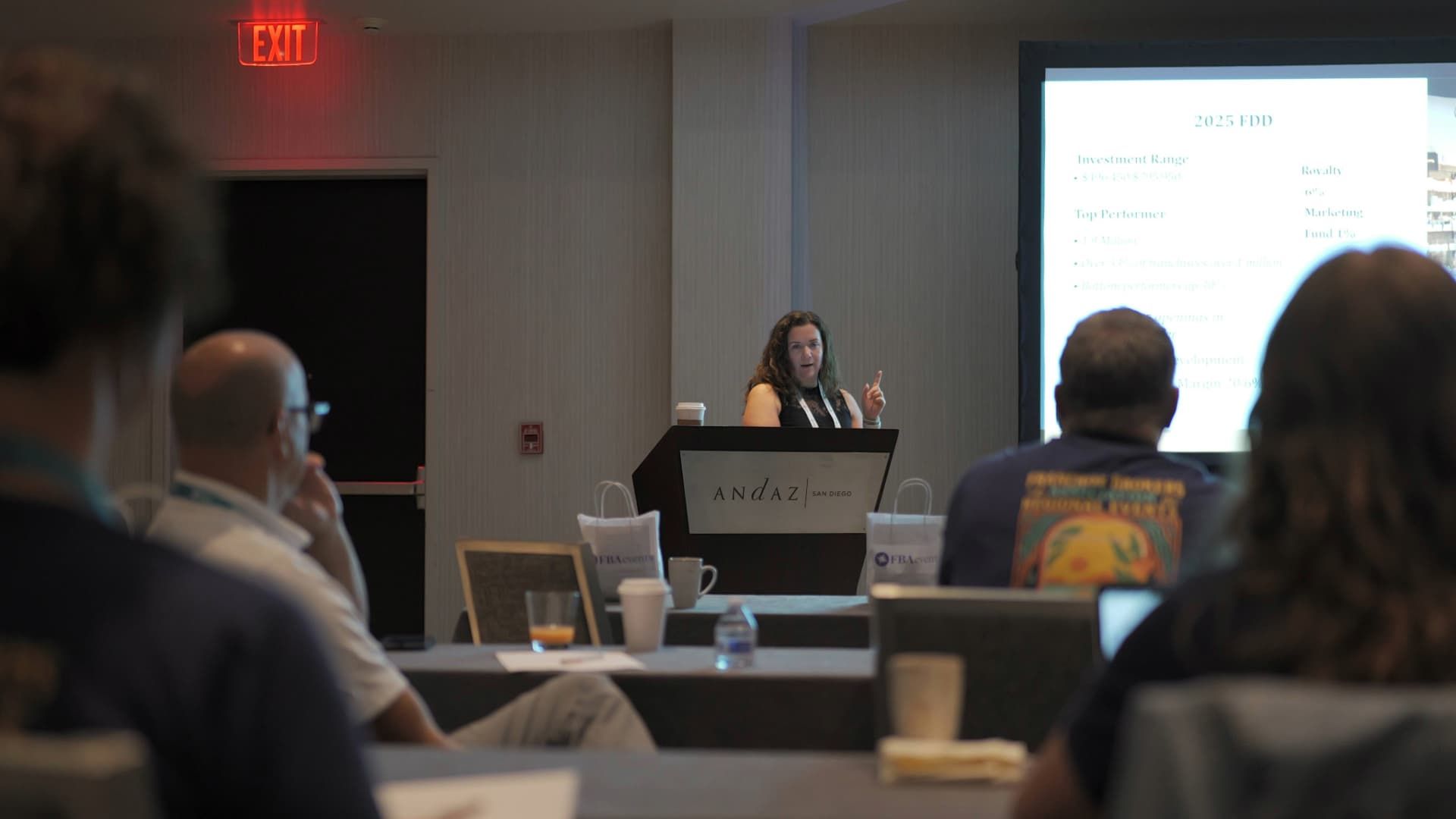
An effective Item 19 franchise broker guide helps brokers discuss disclosed financial information accurately without turning historical results into earnings promises.
To build one, start with your current Franchise Disclosure Document. Create a counsel-reviewed summary using exact approved excerpts, preserve the context behind the figures, and provide a separate conversation guide explaining what brokers may repeat and when they must escalate questions.
The goal is accuracy, not a stronger earnings pitch.
A financial performance representation, or FPR, can support informed candidate evaluation. However, removing a footnote, confusing revenue with income, or suggesting that a candidate will match the average can change the meaning of otherwise accurate information.
Your package should make Item 19 easier to understand—not easier to overstate.
This article is for educational purposes and does not provide legal, financial, or franchise sales advice. Have qualified franchise counsel review your FPR, supporting materials, distribution procedures, and applicable state requirements.
What Is an Item 19 Financial Performance Representation?
Item 19 is the section of the FDD addressing financial performance representations. Depending on the franchisor’s disclosure, it may include historical sales, expenses, profitability measures, or supported projections.
A franchisor is not required to make an FPR. If it does, the representation must meet applicable requirements, including a reasonable basis and written substantiation.
The meaning of each disclosed metric matters:
- Revenue is not owner income.
- An average is not a minimum.
- Mature-outlet results do not automatically describe a new location.
- A selected group does not necessarily represent the entire system.
- Historical results do not establish a candidate’s future performance.
FBA’s guide to the most misunderstood FDD items provides additional background for conversations about financial disclosures and other key sections.
Can a Better Item 19 Package Help Franchise Sales?
A clearer package can support better financial discussions and reduce confusion during discovery. It does not guarantee more sales, faster decisions, or stronger franchisee results.
Historical research provides useful context.
An April 2017 FRANdata report prepared for the IFA Franchise Education and Research Foundation found that brands disclosing financial performance information grew their franchised systems at a compounded annual rate of 15% between 2013 and 2015. Brands disclosing no financial information grew at 11%.
Those figures describe historical franchised-system growth—not broker close rates, franchisee profits, or expected investment returns.
The report also acknowledged uncertainty about cause and effect. Greater transparency might support stronger performance, or stronger-performing brands might be more likely to disclose.
Use the historical IFA/FRANdata research on financial performance representations to discuss transparency. Do not present its roughly decade-old findings as a current forecast or proof that adding an FPR increases sales.
1. Start With the Current FDD
Build your broker resource from the current applicable FDD—not an older sales deck or a spreadsheet shared during a webinar.
Before drafting, confirm:
- FDD issuance and amendment dates
- Applicable version and state-specific requirements
- Item 19 pages and tables being referenced
- Exact metric definitions
- Reporting periods
- Included and excluded outlets
- Required qualifications and warnings
- Permitted uses and distribution procedures
Assign one person to maintain the approved package.
Finance should verify the figures and transcription. Development should assess whether brokers can use the resource correctly. Franchise counsel should review content, context, and distribution.
A summary cannot correct an unsupported underlying FPR.
Plan Ahead for the 2027 FDD Review
If your team prepares its annual FDD work in the first quarter, use the preceding months to collect recurring broker and candidate questions.
Ask:
- Which questions does our disclosure answer clearly?
- Where do candidates confuse sales, expenses, and income?
- Are brokers overlooking outlet exclusions?
- What additional information could we substantiate and appropriately disclose?
- Which materials need revision?
Treat Q1 as a planning window, not a universal legal deadline. Confirm your actual updating and filing schedule with counsel.
Unanswered questions belong in the disclosure review—not in improvised sales responses.
2. Build a One-Page Summary That Preserves Meaning
A one-page summary should help brokers locate and explain approved information. It should not create a more favorable impression than the complete disclosure.
Use one page as a design goal, not a legal limit. If required context cannot fit legibly, expand the resource.
| Summary Component | Information to Preserve |
|---|---|
| Source | Brand, FDD date, page, and table reference |
| Metric | Exact disclosed label and definition |
| Figures | Approved results and relevant headings |
| Reporting period | Dates covered |
| Outlet population | Which outlets are represented |
| Exclusions | Material reasons outlets were omitted |
| Attainment information | Applicable counts and percentages achieving the stated result |
| Qualifications | Relevant assumptions, limitations, and accompanying disclosures |
| Warning | Clear notice that individual results may differ |
| Substantiation | Approved request process and contact |
| Version | Approval date and identifier |
The federal rule requires accompanying information when historical FPRs are disseminated, including specified outlet-population and attainment information and a clear warning about differing individual results.
Review the financial performance representation requirements in 16 CFR § 436.9 with counsel when designing the package.
Exact Quotes Are Not Enough by Themselves
A quotation can be accurate and still mislead when separated from its context.
For example:
- A top-performing group should not be presented as typical.
- An average should not lose the information about how many outlets achieved it.
- A figure should not be separated from material exclusions.
- A revenue table should not become a statement about personal income.
Do not remove important information simply to make the page cleaner.
3. Separate the Financial Excerpt From the Conversation Guide
Give brokers two distinct resources:
- An approved financial summary containing exact FDD excerpts and required context.
- A conversation guide explaining how to introduce the information and handle questions.
This separation helps prevent training language from being mistaken for a quotation from the FDD.
A proposed introduction for legal review might read:
“The franchisor provides financial performance information in Item 19 of its current FDD. Let’s review what the figures measure, which outlets they cover, and the limitations accompanying them. They do not establish what you personally will earn.”
The financial excerpts should remain exact. The conversation guide should use clear, approved language without introducing new claims.
For broader candidate orientation, share FBA’s FDD explanation for franchise candidates, while keeping brand-specific financial discussions tied to the applicable disclosure and approved procedures.
4. Give Brokers Clear Discussion Boundaries
Replace vague instructions such as “Be careful with earnings claims” with practical examples.
| Candidate Question | Approved Direction, Subject to Counsel Review | Avoid |
|---|---|---|
| “What do owners make?” | Identify the disclosed metric and its limitations | Calling revenue take-home income |
| “Will I reach the average?” | Explain the represented population and period | Predicting the candidate’s results |
| “What do the best locations earn?” | Preserve the disclosed grouping and qualifications | Presenting top results as typical |
| “What would my profit be?” | Refer to properly authorized information | Subtracting assumed costs to invent an estimate |
| “When would I recover my investment?” | Follow the approved escalation process | Calculating payback from revenue |
| “Can you finish my spreadsheet?” | Refer planning to independent advisors | Supplying unsupported assumptions |
FBA’s article on avoiding compliance mistakes in broker conversations can support related training and messaging reviews.
Example: “Can I Expect to Reach the Average?”
Proposed response for counsel review:
“The disclosed average describes the outlets and period identified in Item 19. It is not a prediction of your results. Let’s review the definitions, outlet population, and qualifications with the development team.”
Example: “What Would I Take Home?”
If personal income is not disclosed, do not derive it from sales.
Proposed response for counsel review:
“The information we are reviewing does not establish your personal take-home income. I can connect you with the authorized development contact. Your independent financial advisor can also help evaluate your planning assumptions.”
A disclaimer does not make an otherwise unsupported earnings claim acceptable.
5. Establish an Escalation Process for Unanswered Questions
Brokers should know what to do when Item 19 does not answer a candidate’s question.
Use a repeatable process:
- Record the question.
- Check whether approved materials address it.
- Refer unresolved questions to the authorized contact.
- Obtain legal review where necessary.
- Document the approved response.
Limited exceptions exist for certain information, including qualifying supplemental representations and actual operating records for an existing outlet offered for sale. Have counsel determine whether an exception applies and how the information may be provided.
Do not treat exceptions as permission to improvise.
The Internicola Law Firm’s franchise sales compliance guidance offers additional context for coordinating sales communications with legal requirements.
Do Not Use Validation as an Earnings Workaround
Independent franchisee conversations can support candidate due diligence. However, do not coach owners to provide claims that your sales team cannot make or present selected owners as an unofficial earnings presentation.
The same caution applies to AI-generated forecasts. A broker should not endorse a model or add assumptions in ways that create an unauthorized representation.
6. Train Brokers With Real Questions
Do not distribute the summary without explaining how it should be used.
A short training session should cover:
- What each metric measures
- What it does not measure
- Which outlets and periods are included
- Important exclusions and qualifications
- Required warnings
- Substantiation requests
- Candidate-specific questions
- Version control and escalation
Practice with questions such as:
- “Could someone with my experience beat the average?”
- “What is a realistic first-year profit?”
- “How long before I break even?”
- “Can you give me an estimate off the record?”
The goal is not to produce a persuasive answer to every question. It is to recognize when an answer would go beyond authorized information.
7. Control Versions and Review Actual Use
Maintain one approved source for the broker package.
When the applicable FDD or financial information changes:
- Review affected summaries and scripts.
- Replace outdated files.
- Notify brokers directly.
- Retire old presentations where possible.
- Record approval and retirement dates.
- Confirm that the appropriate version is being used.
Review communications through authorized processes. Look for altered figures, missing qualifications, unsupported commentary, and outdated attachments.
Useful measures include:
- Current-version usage
- Training completion
- Unresolved financial questions
- Requests for clarification
- Identified messaging issues
- Completion of corrective actions
Do not judge the package only by close rate. Its value also lies in accurate communication and better-informed candidate evaluation.
Item 19 Broker Summary Template
This template is a planning tool, not a ready-to-distribute financial representation. Complete it using your current applicable FDD and obtain legal approval.
Source and Version
Brand: [Name]
FDD date and amendments: [Dates]
Source: Item 19, page [number], table [identifier]
Approved audience and use: [Instructions]
Exact Approved Excerpt
[Insert the selected FDD language and table content exactly, with required context.]
Definitions and Reporting Period
[Insert applicable definitions and dates.]
Outlet Population and Attainment
[Include required population details, material exclusions, and applicable achievement counts and percentages.]
Qualifications and Warning
[Insert approved qualifications and the required warning clearly and conspicuously.]
Substantiation and Questions
Authorized contact: [Name and contact information]
Request procedure: [Approved instructions]
Approval date: [Date]
Version: [Identifier]
If these elements cannot fit legibly on one page, expand the resource.
Item 19 Packaging Checklist
Before release, confirm:
- The package matches the current applicable FDD.
- Excerpts and figures have been verified.
- Metric definitions and reporting periods are visible.
- Outlet populations and exclusions remain clear.
- Required attainment information is included.
- Warnings are prominent.
- No unsupported calculations or projections appear.
- Permitted use and distribution are documented.
- Brokers have a separate conversation guide.
- Escalation and substantiation contacts are identified.
- Outdated materials will be retired.
- Franchise counsel has approved the package.
How This Fits Into Your FBA Broker Strategy
Financial communication should be part of broker onboarding—not an informal discussion after a candidate asks about earnings.
When you partner with franchise brokers, explain where the current approved materials are located, who answers financial questions, and how changes will be communicated.
If you are evaluating franchise broker network membership, consider whether your team can maintain accurate resources and deliver consistent training alongside its visibility goals.
Explore FBA’s franchisor membership options to compare available support with your brand’s needs. Membership participation does not replace your legal review, disclosure obligations, or responsibility for approved messaging.
Frequently Asked Questions
Can Franchise Brokers Discuss Item 19 Numbers With Candidates?
Generally, brokers may discuss properly disclosed financial information under applicable requirements and approved procedures. They must preserve required context and warnings and avoid unsupported projections or promises. Internal approval alone does not make an unlawful representation compliant.
What Happens if a Franchisor Shares Financial Data Outside Item 19?
An unauthorized financial performance representation can create federal or state compliance exposure, even if the underlying figure is accurate. Potential consequences depend on the facts and applicable law. Preserve the communication and consult franchise counsel promptly. Limited exceptions require careful review.
Does Including an Item 19 Help Franchise Sales?
It can support informed discovery, but it does not guarantee sales. Historical FRANdata research associated financial disclosure with faster franchised-system growth during 2013–2015. It did not establish causation or measure current broker close rates.
Is an Exact FDD Quote Automatically Compliant?
No. A quote can become misleading when separated from definitions, population details, exclusions, attainment information, or warnings. The material’s presentation, distribution, and spoken explanation also matter.
What Should Brokers Say if the Brand Does Not Make an FPR?
They should not supply informal earnings estimates. Use approved information about the business model, investment requirements, owner responsibilities, and support. Direct financial questions to the authorized team and follow counsel’s guidance.
Does the Summary Replace the FDD?
No. A broker summary supports communication. It does not replace the FDD, required disclosure procedures, substantiation obligations, or candidate due diligence.
Make Item 19 Easier to Understand, Not Easier to Overstate
A useful Item 19 franchise broker package keeps financial figures attached to their meaning.
Start with the current FDD. Preserve the context. Give brokers repeatable language and a clear escalation path. Train them to recognize when a question requires review rather than another calculation.
That approach supports more informed conversations without turning your financial disclosure into a promise it was never intended to make.