

Effective FBCE conference follow-up for franchise brokers follows four steps: document the conversation, ask a candidate-specific question, decide whether the brand belongs on a shortlist, and arrange an introduction when the candidate is ready. Record an owner and next action at each stage so useful information does not remain buried in conference notes.
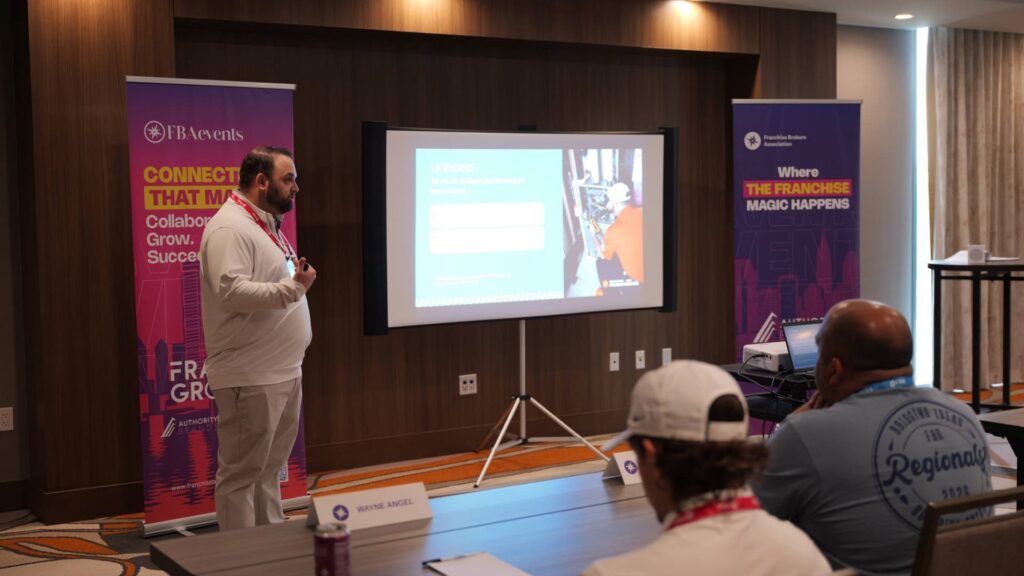
FBA listed its 2026 Annual Conference & Expo for November 8–10 at the Hyatt Regency Grand Cypress Resort in Orlando. With the event behind you, the next task is to separate promising conversations from opportunities that genuinely fit your candidates.
A business card gives you a contact. A presentation gives you information. Neither establishes candidate fit.
This 30-day playbook helps you turn those starting points into a focused research process inside BOS—without treating every conference conversation as a future deal.
What Should Your FBCE Follow-Up Accomplish?
By the end of 30 days, each meaningful franchisor conversation should have a documented outcome:
- Active research for a specific candidate.
- An important question awaiting clarification.
- A useful relationship retained for future candidates.
- A brand removed from a particular candidate’s shortlist.
- A candidate-approved introduction scheduled or completed.
A candidate-ready shortlist is a small set of brands with a documented reason for further investigation. It is not a list of approved investments or every brand that made a good impression.
FBA’s guides to building relationships at franchise broker events and developing a referral-first practice through FBA events cover the relationship foundation. This plan addresses what happens after you return home.
Your 30-Day Follow-Up Plan at a Glance
| Period | Main action | What you should have afterward |
|---|---|---|
| Week 1: Days 1–7 | Log every franchisor conversation in BOS | Organized records, sources, and assigned next steps |
| Week 2: Days 8–14 | Ask each new contact one useful question | An answer that tests fit or a tracked open issue |
| Week 3: Days 15–21 | Promote, retain, or retire brands | A focused candidate shortlist with reasons |
| Week 4: Days 22–30 | Arrange appropriate introductions | Permission, a clear handoff, and a planned debrief |
These intervals are a suggested workflow, not an FBA requirement. If you are beginning late, start with the same sequence today. Do not compress it into a generic email campaign to catch up.
Week 1: Log Every Franchisor Conversation in BOS
Consolidate your business cards, handwritten notes, emails, and materials in the appropriate BOS records. Check for existing contacts before creating new ones so a familiar relationship does not become a duplicate.
FBA’s Broker Operating System describes a HubSpot-based framework for records, tasks, activity tracking, and pipeline visibility. Use your existing configuration to connect the contact, conversation, and follow-up.
The goal is not perfect data entry. It is preserving enough context to make a responsible next decision.
Use a Consistent Conference Note
| Field | What to record |
|---|---|
| Contact | Correct name, role, brand, and preferred contact details |
| Conversation | Where you spoke and the main subject |
| Possible alignment | Candidate characteristics that may fit |
| Potential mismatch | Constraints or responsibilities that may not fit |
| Source | Conversation, presentation, current disclosure, or other material |
| Promised information | What was offered and who will provide it |
| Open question | The most important missing detail |
| Next action | Owner, due date, and purpose |
| Review status | Preliminary, clarification pending, or ready for a candidate discussion |
Use existing fields, notes, and tasks where possible. These are suggested data points, not default BOS fields.
Separate Statements From Conclusions
A useful note might read:
“Representative described the model as manager-led after launch. Launch-stage owner involvement remains unclear. Request clarification before considering it for candidates who plan to keep their jobs.”
A weaker note would read:
“Great semi-absentee option.”
The first preserves what you heard and what you still need to investigate. The second turns incomplete information into a recommendation.
Label missing information as unknown. Do not fill gaps from memory or repeat financial statements from a booth conversation as verified earnings information.
Track What You Owe, Too
If you promised to send a resource or arrange another conversation, assign yourself a task. Follow-up should capture mutual commitments rather than function only as a list of requests for the franchisor.
Before ending Week 1, every meaningful conversation should have a next action or a documented reason why no action is needed.
Week 2: Send One Candidate-Specific Question to Each New Contact
Review your live candidates before writing. Choose one question that could change whether a brand deserves further consideration.
FBA’s franchise candidate qualification guide can help you revisit goals, available time, financial parameters, experience, and readiness.
Do not force a candidate connection where none exists. The purpose is to test a plausible fit—not imply that every representative should expect a referral.
Choose the Question That Matters Most
| Candidate consideration | Useful follow-up question |
|---|---|
| Wants to keep a current job | “What owner involvement is required during launch before delegation becomes realistic?” |
| Prefers a small team | “What staffing structure should an owner expect, and which responsibilities remain theirs?” |
| Has a defined market | “Is this market currently available for review, and how is availability confirmed?” |
| Enjoys relationship-based selling | “Which owner-led business development activities are central to the model?” |
| Has limited financial flexibility | “Which current investment and liquidity requirements should be reviewed before an introduction?” |
Ask for the current guidance or source supporting the answer. “Send me everything” is less useful than a question tied to the candidate’s main constraint.
Franchisor Follow-Up Email Template
Subject: Following up from FBCE: one question about owner involvement
Hi [Representative Name],
We spoke at FBCE about [specific detail]. Thank you for explaining [useful point].
I am researching options for a candidate whose goals include [brief, non-identifying criteria]. Before deciding whether your brand belongs on their research shortlist, I would like to clarify one point:
[One focused question.]
Could you share the current guidance or material that addresses it? I am checking fit before recommending a further conversation, rather than making a referral at this stage.
Best,
[Broker Name]
Keep the outline appropriately anonymized. Do not send identifying or sensitive candidate information without permission.
If There Is No Current Match
Be direct:
“I do not have a live candidate match today, but I want to understand your model better. Which owner responsibility is most often misunderstood before an introduction?”
That keeps the relationship useful without overstating your pipeline.
If the representative does not respond, make a reasonable follow-up consistent with the relationship and their preferences. Leave the issue unresolved; silence is not confirmation.
Week 3: Promote, Retain, or Retire Brands
Review the answers and supporting information. Then decide which brands deserve more attention.
Keep two lists distinct:
- Your brand research list contains relationships and information that may be useful.
- A candidate shortlist contains options with a specific reason for further investigation.
A brand can belong on the first without belonging on the second.
Use Four Working Statuses
| Status | Meaning | Next action |
|---|---|---|
| Active candidate research | Plausible alignment and enough information to justify exploration | Discuss with the candidate |
| Clarification pending | A material question remains unanswered | Assign follow-up |
| Future-fit reference | Useful information, but no current match | Set an appropriate review point |
| Retired for this candidate | A confirmed mismatch exists | Record the reason |
These are proposed labels, not instructions to change shared BOS pipeline stages. Follow your team’s configuration and permissions.
Apply a Candidate-Fit Review
Before promoting a brand, ask:
- Does the owner role align with the candidate’s goals?
- Is the candidate willing and able to perform the required work?
- Are financial assumptions current and accurately described?
- Is the preferred market available for investigation?
- Does the timing make sense?
- Which important questions remain?
- Does the candidate want to learn more?
FBA’s brand evaluation framework for brokers provides a deeper structure for this review.
A confident representative, attractive presentation, or referral arrangement should not outweigh a candidate’s non-negotiable constraint.
Record Why You Removed an Option
Instead of “not a fit,” write:
“Removed from this candidate’s shortlist because launch-stage owner involvement conflicts with current availability. Retain as a reference for candidates seeking hands-on ownership.”
Retiring a brand for one candidate does not require ending the relationship. A clear reason preserves useful knowledge and makes future conversations more precise.
A Practical Example: One Conversation, Two Different Outcomes
Consider a hypothetical conference discussion about a service franchise that requires significant owner-led selling during launch.
One candidate wants an active relationship-building role. Another wants limited involvement from the start.
The same follow-up answer may justify promoting the brand for the first candidate and removing it for the second. Neither decision means the brand is universally good or bad.
The value of conference research comes from applying information to a person’s circumstances—not assigning every brand a single overall score.
Week 4: Book Introductions for Ready Candidates
Before arranging a call, explain the potential alignment, identify unresolved questions, and ask whether the candidate wants to proceed.
The FTC’s guide to buying a franchise emphasizes independent investigation, current disclosures, conversations with franchisees, and qualified professional advice. A conference relationship does not replace that work.
An introduction begins another stage of research. It is not an endorsement or a commitment.
Complete the Pre-Introduction Check
Confirm:
- The candidate’s goals and constraints are current.
- The candidate understands why the brand is being considered.
- Financial and funding assumptions are accurately described.
- Territory information has been checked recently.
- Owner-role questions have been addressed or identified.
- The candidate agrees to the introduction and information sharing.
- The representative understands the purpose of the call.
- A candidate debrief is planned.
Do not describe the candidate as financially approved or committed unless that statement is supported and appropriate.
Candidate Introduction Email Template
Subject: Introduction: [Candidate Name] and [Brand Representative]
Hi [Representative Name] and [Candidate Name],
With [Candidate Name]’s permission, I am connecting you for an initial conversation about [Brand].
[Candidate Name] is exploring ownership with a focus on [agreed goals]. The potential alignment we identified is [specific reason].
An important topic for the first call is [open question]. This is an opportunity to investigate fit, not a commitment to proceed.
[Representative Name], please coordinate a suitable time with [Candidate Name]. I will reconnect with [Candidate Name] afterward to discuss what they learned.
Best,
[Broker Name]
Confirm the information and recipients before sending. Permission to speak with one brand is not permission to distribute a candidate’s details broadly.
Schedule the Debrief Before You Lose Context
Ask:
- “What did you understand differently after the call?”
- “Which responsibilities fit your goals?”
- “What concerns remain?”
- “Do you want to continue, pause, or remove this option?”
Update the shortlist using the candidate’s response—not only the representative’s assessment of the call.
Turn Each Decision Into a BOS Task
A note explains what happened. A task identifies what happens next.
For example:
- Task: Request clarification of launch-stage owner responsibilities.
- Owner: Assigned broker.
- Due date: Agreed follow-up date.
- Completion: Request sent and the response or nonresponse documented.
- Review: Decide whether the brand remains under consideration.
Do not define task completion as “representative replies” or “candidate books.” Those outcomes are not entirely under your control.
HubSpot’s task-creation guide explains assignments, due dates, notes, and record associations. Confirm your account’s available features before relying on automation.
Starting Late? Use a Reset, Not an Apology Campaign
If more than a week has passed, begin with the same sequence:
- Consolidate the notes.
- Prioritize plausible candidate matches.
- Reference the original conversation.
- Ask one useful question.
- Assign a review date.
A simple opening is enough:
“I am working through my FBCE notes and wanted to return to our conversation about [topic]. Before considering a candidate introduction, could you clarify [question]?”
Do not invent urgency or imply that a referral is ready to compensate for delayed outreach.
Measure Decisions, Not Just Emails
Useful FBCE conference follow-up for franchise brokers should produce better information and clearer choices.
| Measure | What it shows |
|---|---|
| Conversations documented | Information was preserved |
| Focused questions sent | Outreach had a research purpose |
| Material questions answered | Uncertainty decreased |
| Brands promoted or retired | The shortlist changed for a reason |
| Introductions accepted | Candidates chose to investigate |
| Calls completed | Planned conversations happened |
| Debriefs completed | Learning returned to the record |
Track applications, Discovery Day visits, and agreements separately. They are different milestones.
The 30-day goal is not to force a conference contact into a deal. It is to build a more useful shortlist and a reliable path for appropriate introductions.
Common Post-Conference Mistakes
Avoid:
- Sending identical messages to every contact.
- Treating all contacts as active opportunities.
- Recording informal statements as verified facts.
- Adding brands without revisiting candidate criteria.
- Sharing personal information too early.
- Leaving promises without an owner.
- Keeping a brand active despite a confirmed mismatch.
- Booking calls without candidate agreement.
- Measuring message volume instead of resolved questions.
- Forgetting the candidate debrief.
Frequently Asked Questions
What should franchise brokers do in the first week after FBCE?
Log meaningful conversations, consolidate duplicate records, separate informal statements from confirmed information, and assign next actions. Record both the representative’s promises and your own commitments.
How do I decide which conference brands belong on my shortlist?
Compare current information with a specific candidate’s goals, owner-role preferences, financial parameters, market, and timing. Keep material unknowns visible. A useful contact does not automatically belong on a candidate shortlist.
How should I follow up with franchise development representatives from FBA events?
Reference the conversation and ask one focused question that tests fit. Request current supporting information and clarify whether you are researching or making an actual referral.
What if no current candidate fits the brand?
Retain the contact as a future-fit reference. Be honest that there is no live match, and document what you need to understand before reconsidering.
Should every promising brand receive a candidate introduction?
No. First review the potential alignment, identify open questions, and obtain candidate agreement. An introduction should serve the candidate’s investigation, not a conference quota.
Is it too late to start after the first week?
No. Begin with documentation and work through clarification, shortlist decisions, and appropriate introductions. A specific late message is more useful than rushed generic outreach.
Make Every Follow-Up Earn Its Place
A conference conversation becomes valuable when it helps you ask a better question, understand a brand more accurately, or identify an appropriate candidate introduction.
Preserve the context, test the fit, and document the decision. Keep relationships even when there is no immediate match, but reserve active shortlists for options that deserve further investigation.
If your records and next actions remain scattered, explore FBA’s Broker Operating System and ask how its franchise broker CRM and brokerage tools could support your workflow.
This article provides educational information, not legal, financial, tax, or investment advice. Conference discussions and preliminary research do not replace current disclosures, independent investigation, or qualified professional guidance.